Posts

Showing posts with the label Physics

Find the (a) maximum frequency (b) minimum wavelength of X-rays produced by 30 kV electrons.
Image
Question Id:  PH0000012 Question : Find the  (a) maximum frequency (b) minimum wavelength of X-rays produced by 30 kV electrons. Answer : (a) Maximum frequency of the X-ray produced by 30kV electron is \(\ 7.253 \times 10^{18}Hz \). (b) Minumum wavelength ( \(\lambda\) ) is \(0.41 \) angstroms. Explanation : Given, potential \(V=30kV\)                    \(\Rightarrow V=30 \times 10^3V\)                    \(\Rightarrow V=3 \times 10^4V\) So, energy of the X-ray is \(E=3 \times 10^4eV\) [ \(1eV=1.602\times 10^{-19}J\) ] We know a particle having frequency ( \(\nu\) ) contain energy \(E=h\nu\) ; where h is Planck's constant \(h=6.626\times 10^{-34}Js\) \[\Rightarrow \nu =\frac{E}{h}\] \[\Rightarrow \nu =\frac{1.602\times 10^{-19} \times 3 \times 10^{4}}{6.626\times 10^{-34}}\] \[\Rightarrow \nu =\frac{1.602 \times 3\times 10^{19} }{6.626}\] \[\Rightarrow \nu =0.7253 \times ...
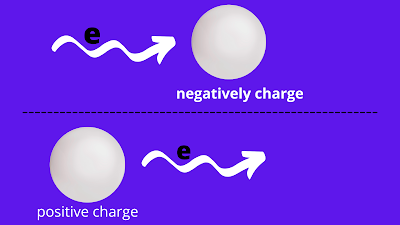
A polythene piece rubbed with wool is found to have a negative charge of \(3×10^{–7} C\)

Image
Question Id:  PH0000011 Question : A polythene piece rubbed with wool is found to have a negative charge of \(3×10^{–7} C\).  (a) Estimate the number of electrons transferred (from which to which?)  (b) Is there a transfer of mass from wool to polythene? Answer :   (a) From wool to polythene  (b) Yes, but amount of mass is very less \(1.7079 \times 10^{-18} Kg\) Explanation :   (a) As we know an atom has neutral charge because it has same number of  electron and proton. Charge of an atom or object depends on number of electron loss or gain. If any atom gain electron then it gets negatively charge (due to negative charge of electron) or if any atom loss electron then it gets positive charge (because number of electron is less than number f proton).    As polythene is fund to be negative charge that means electron is transferred from wool to polythene. From the quantisation of charge one can say that any amount of  discrete charge (Q) i...

An electric dipole with dipole moment \(4 × 10^{–9}\) C.m is aligned at 30° with the direction of a uniform electric field of magnitude \(5 × 10^4 NC^{–1}\) . Calculate the magnitude of the torque acting on the dipole.

Image
Question Id:  PH0000010 Question :  An electric dipole with dipole moment \(4\times 10^{-9} C.m\) is aligned at 30° with the direction of a uniform electric field of magnitude \(5\times 10^{4} NC^{-1}\) . Calculate the magnitude of the torque acting on the dipole. Answer : \( 10^{-4} Nm\)  Explanation : Given,  Dipole moment (p)= \(4\times 10^{-9} C.m\) Electric field (E)= \(5\times 10^{4} NC^{-1}\) And \( \theta =30 \) Fig-1: Torque acting on dipole due to electric field We, know if angle between dipole moment \( p\) and electric field (E) is \( \theta\) then torque ( \( \tau \) ) acting on the dipole is  \(\implies \tau =pE {sin \theta}\)  \(\implies \tau = 4\times 10^{-9} \times 5\times 10^{4} \times {sin 30} \)  \(\implies \tau = 4\times 10^{-9} \times 5\times 10^{4} \times \frac{1}{2} \)  \(\implies \tau = 20 \times 10^{-5}  \times \frac{1}{2} \)  \(\implies \tau = 10 \times 10^{-5} \)  \(\implies \tau =  1...

Explain why two field lines never cross each other at any point?

Image
Question Id:  PH0000009 Question:  Explain why two electrostatic field lines never cross each other at any point? Explanation: Electrostatic field lines are imaginary line which indicates the direction of electric field at any point and direction is along the tangent of the field lines. If two line corss at any point that means for the particular point the line can represent two different direction of field and which is not possible [For a particular point the direction of field is unique]. Thats why two field lines never cross each other at any point.  Fig-1: Direction of electric field lines N.B: Direction of field line from a positive charge paricle is away from the particle and direction of field line for negative charge particle is towards the particle.  -------------------------------------------------------------------- ⭐ Related question answer from Reading tab: What is the force between two small charged spheres having charges of \(2\times 10^{-7}C\) and \(...

Explain the meaning of the statement ‘electric charge of a body is quantised'.

Image
Question Id:  PH0000008 Question: Explain the meaning of the statement ‘electric charge of a body is quantised'. Answer : Charge( may be positive or negative) of any body is integral multiple of electronic charge. This phenomena is quantisation of charge. If a body has \(Q\) amount of charge then it can be say from the quantisation of charge that \(Q=\pm ne\) where \(e\) is electronic charge [ \(e=-1.6 \times 10^{-19}C\) ] and \(n=1,2,3,4,......\) Fig-1: Quantisation of charge Explanation : A body get charged in two way By losing some electron By gaining some electrons An atom has equal number of proton and electron due to ths fact in general an atom is neutral but w hen a body lose some electron then it become positively charged in this case number of proton is more in the atom and when gain some electron it become negatively charged as in this case number of electron is more in the atom. As fraction number of electron can not be transferred (lose or gain) so it means a bod...

Four point charges qA=2μC, qB=−5μC, qC=2μC, and qD=−5μC are located at the corners of a square ABCD of side 10 cm. What is the force on a charge of 1 µC placed at the centre of the square?

Image
Question Id:  PH0000007 Question :   Four point charges qA = 2 µC, qB = –5 µC, qC = 2 µC, and qD = –5 µC are located at the corners of a square ABCD of side 10 cm. What is the force on a charge of 1 µC placed at the centre of the square? Answer : zero  Explanation :  According to the given question you can draw the figure look like as given below.   Fig-1: Coulomb's Force at the centre of square Let, side of the square is a unit. Then length of the corner is \(a\sqrt{2}\) . So, the distance froom centre to corner is \(\frac{a}{\sqrt{2}}\) . Given \(2\mu C\) charge will apply foce towards the centre. For both the \(2\mu C\) the applied forces on \(1\mu C\) chrge are equal and opposite to each other. And value of the force is  \(F=\frac{1}{4 \pi \epsilon_0} \times \frac{1 \times 2}{(\frac{a}{\sqrt 2})^{2}} \mu N\) \[\Rightarrow F=\frac{1}{4 \pi \epsilon_0} \times \frac{4}{a^{2}} \mu N\] As the force are opposite and equal so  the resultant...

The electrostatic force on a small sphere of charge 0.4 µC due to another small sphere of charge –0.8 µC in air is 0.2 N. (a) What is the distance between the two spheres? (b) What is the force on the second sphere due to the first?

Image
Question Id:  PH0000006   Question :  The electrostatic force on a small sphere of charge 0.4 µC due to another small sphere of charge –0.8 µC in air is 0.2 N. (a) What is the distance between the two spheres? (b) What is the force on the second sphere due to the first? Answer : (a) Distance between the two spheres is 0.12m. (b) Force on the second sphere due to the first sphere is save and i.e  0.2 N. Explanation : Given,  two small charge \(q_{1}=0.4\mu C=0.4\times 10^{-6}C=4\times 10^{-7}C\) ,  \(q_{2}=-0.8\mu C=-0.8\times 10^{-6}C=-8\times 10^{-7}C\)   and force(F)  between them is 0.2 N. Distance between the sphere of charges is r (say) Figure-1: force between 0.4 µC and –0.8 µC According to Coulomb's law  If two point charge \(q\) and \(Q\) are separated by a distance \(r\) then electrostatic force acting on them is \(F=\frac{1}{4\pi \epsilon }\frac{qQ}{r^{2}}\)     ;[where \(\epsilon\) is electric permittivity ...

What is the force between two small charged spheres having charges of 2×10⁻⁷C and 3×10⁻⁷C placed 30cm apart in air ?

Image
Question Id:  PH0000005 Question :  What is the force between two small charged spheres having charges of \(2\times 10^{-7}C\) and \(3\times 10^{-7}C\) placed 30 cm apart in air? Answer :   F orce acting  between \(q\) and \(Q\) is \(6\times 10^{-4}N\) Explanation :   Given two charge \(q=2\times 10^{-7}C\) and  \(Q=3\times 10^{-7}C\) And they are separated by a distance \(r=30cm \Rightarrow r=0.3m\) Figure-1 According to Coulomb's law  If two point charge \(q\) and \(Q\) are separated by a distance \(r\) then electrostatic force acting on them is \(F=\frac{1}{4\pi \epsilon }\frac{qQ}{r^{2}}\)     ;[where \(\epsilon\) is electric permittivity and  \(\epsilon =k\epsilon_{0}\) where k is dielectric constant and  \(\epsilon_{0}\) is electric permittivity for air medium] Now Force between \(q\) and \(Q\) is  \(F=\frac{1}{4\pi \epsilon _{0}}\frac{qQ}{r^{2}}\) ;[at air medium \(\epsilon =\epsilon_{0}\)  as \(k=1\)] \[\Right...

Project on atomic model and history || Class 12 physics Project on atomic model and history

Image
Project on atomic model and history:            Atom is the smallest constituent unit of ordinary matter that constituent of chemical elements viz electron, proton, neutron. Atoms are extremely small, typical sizes are around 100 picometers. In 1800 AD Jhon Dalton use the concept of atom to explain why chemical elements seemed to combine in ratios of small whole numbers. And Dalton give the atomic theory famous as "Dalton's atomic theory". Atom is mainly consist of two main part as nucleus and electron shell. The nucleus is made of proton and neutron. Proton is positively charged and neutron has no charge i.e neutral. And electron is negatively charge. diagram of electron and proton Discovery of Electron:      In 1897, J J Thomson  discovered that cathode rays are not electromagnetic waves but are made of particles taht are 1800 times lighter than hydrogen (the lightest atom). And that particle are electron and it is negatively charged. ...

Project Report on semiconductors || Class 12 physics project on semiconductor

Image
Project Report on semiconductors:- INTRODUCTION:          Most of the solids can be define into three classes: 1) conductor 2) insulator and  3) semiconductor (1)  conductor : those solids can be called as conductor who have good electric conductivity property. Conductivity define by the presence of free electron. That means conductor have free electron by which it can easily conduct current. Example:- copper, iron etc. (2)  insulator :     those solid can be called insulator who have no electric conductivity. That means insulator have no free electron and hence they cannot conduct current. Example:- wood, glass etc. (3)  semiconductor :   semiconductor are those solid whose electric conductivity is between conductor and insulator. Semiconductor can conduct current in some particular conditions.    Theory:-             The energy band structure of the semiconductors is simi...