Posts

Showing posts from March, 2021

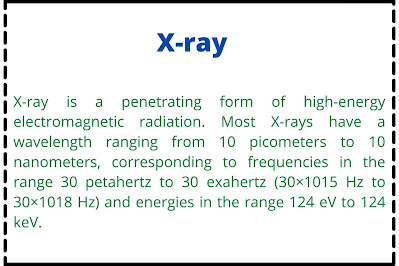
Find the (a) maximum frequency (b) minimum wavelength of X-rays produced by 30 kV electrons.
Image
Question Id:  PH0000012 Question : Find the  (a) maximum frequency (b) minimum wavelength of X-rays produced by 30 kV electrons. Answer : (a) Maximum frequency of the X-ray produced by 30kV electron is \(\ 7.253 \times 10^{18}Hz \). (b) Minumum wavelength ( \(\lambda\) ) is \(0.41 \) angstroms. Explanation : Given, potential \(V=30kV\)                    \(\Rightarrow V=30 \times 10^3V\)                    \(\Rightarrow V=3 \times 10^4V\) So, energy of the X-ray is \(E=3 \times 10^4eV\) [ \(1eV=1.602\times 10^{-19}J\) ] We know a particle having frequency ( \(\nu\) ) contain energy \(E=h\nu\) ; where h is Planck's constant \(h=6.626\times 10^{-34}Js\) \[\Rightarrow \nu =\frac{E}{h}\] \[\Rightarrow \nu =\frac{1.602\times 10^{-19} \times 3 \times 10^{4}}{6.626\times 10^{-34}}\] \[\Rightarrow \nu =\frac{1.602 \times 3\times 10^{19} }{6.626}\] \[\Rightarrow \nu =0.7253 \times ...

What is global warming? Write the cause of global warming?

Image
Question Id: BIO000001 Question :  What is global warming? Write the cause of global warming? Answer :   Rising average air temperatures near Earth’s surface is known as global warming. It causes heating on earth surface and ocean. Due to rising of heat, ice of north and south pole and the Himalaya are melting. It causes rising height of sea level is increasing. It is very dangerous for the earth, the ecosystem of the earth is in danger. Fig-1: global warming Causes of global warming: Global Warming is caused by many things. The causes are divided into two groups, man-made or anthropogenic causes, and natural causes. Natural Causes: Natural causes are causes created by nature. One natural cause of global warming is a release of methane gas from arctic tundra and wetlands.  Another natural cause of global warming is that the earth goes through a cycle of climate change. Man-made Causes: the man made cause of global warming are CO2 from power plants, pollution emitte...

A polythene piece rubbed with wool is found to have a negative charge of \(3×10^{–7} C\)

Image
Question Id:  PH0000011 Question : A polythene piece rubbed with wool is found to have a negative charge of \(3×10^{–7} C\).  (a) Estimate the number of electrons transferred (from which to which?)  (b) Is there a transfer of mass from wool to polythene? Answer :   (a) From wool to polythene  (b) Yes, but amount of mass is very less \(1.7079 \times 10^{-18} Kg\) Explanation :   (a) As we know an atom has neutral charge because it has same number of  electron and proton. Charge of an atom or object depends on number of electron loss or gain. If any atom gain electron then it gets negatively charge (due to negative charge of electron) or if any atom loss electron then it gets positive charge (because number of electron is less than number f proton).    As polythene is fund to be negative charge that means electron is transferred from wool to polythene. From the quantisation of charge one can say that any amount of  discrete charge (Q) i...

An electric dipole with dipole moment \(4 × 10^{–9}\) C.m is aligned at 30° with the direction of a uniform electric field of magnitude \(5 × 10^4 NC^{–1}\) . Calculate the magnitude of the torque acting on the dipole.

Image
Question Id:  PH0000010 Question :  An electric dipole with dipole moment \(4\times 10^{-9} C.m\) is aligned at 30° with the direction of a uniform electric field of magnitude \(5\times 10^{4} NC^{-1}\) . Calculate the magnitude of the torque acting on the dipole. Answer : \( 10^{-4} Nm\)  Explanation : Given,  Dipole moment (p)= \(4\times 10^{-9} C.m\) Electric field (E)= \(5\times 10^{4} NC^{-1}\) And \( \theta =30 \) Fig-1: Torque acting on dipole due to electric field We, know if angle between dipole moment \( p\) and electric field (E) is \( \theta\) then torque ( \( \tau \) ) acting on the dipole is  \(\implies \tau =pE {sin \theta}\)  \(\implies \tau = 4\times 10^{-9} \times 5\times 10^{4} \times {sin 30} \)  \(\implies \tau = 4\times 10^{-9} \times 5\times 10^{4} \times \frac{1}{2} \)  \(\implies \tau = 20 \times 10^{-5}  \times \frac{1}{2} \)  \(\implies \tau = 10 \times 10^{-5} \)  \(\implies \tau =  1...

Explain why two field lines never cross each other at any point?

Image
Question Id:  PH0000009 Question:  Explain why two electrostatic field lines never cross each other at any point? Explanation: Electrostatic field lines are imaginary line which indicates the direction of electric field at any point and direction is along the tangent of the field lines. If two line corss at any point that means for the particular point the line can represent two different direction of field and which is not possible [For a particular point the direction of field is unique]. Thats why two field lines never cross each other at any point.  Fig-1: Direction of electric field lines N.B: Direction of field line from a positive charge paricle is away from the particle and direction of field line for negative charge particle is towards the particle.  -------------------------------------------------------------------- ⭐ Related question answer from Reading tab: What is the force between two small charged spheres having charges of \(2\times 10^{-7}C\) and \(...